
September is Healthy Aging Month, which makes it a good time to talk about something most of us encounter every single day: sugar.
When we talk about healthy aging, people often think about cholesterol, blood pressure, exercise, supplements, hormones or maintaining a healthy weight. Blood sugar deserves a place on that list too… How often glucose rises, how high it rises, how efficiently insulin brings it back down, and how well our muscles use that glucose are all part of our metabolic health.
Most people aren’t aware that metabolic health and blood sugar regulation influences far more than whether someone eventually develops diabetes. Over time, poor glucose regulation and insulin resistance are associated with cardiovascular disease, cognitive decline/dementia, inflammation and many of the chronic diseases that become increasingly common as we age.
It’s our goal to support you in understanding where sugar is coming from, how much you’re actually consuming, and what your body does with it.
Sugar Is Hiding in More Places Than Dessert
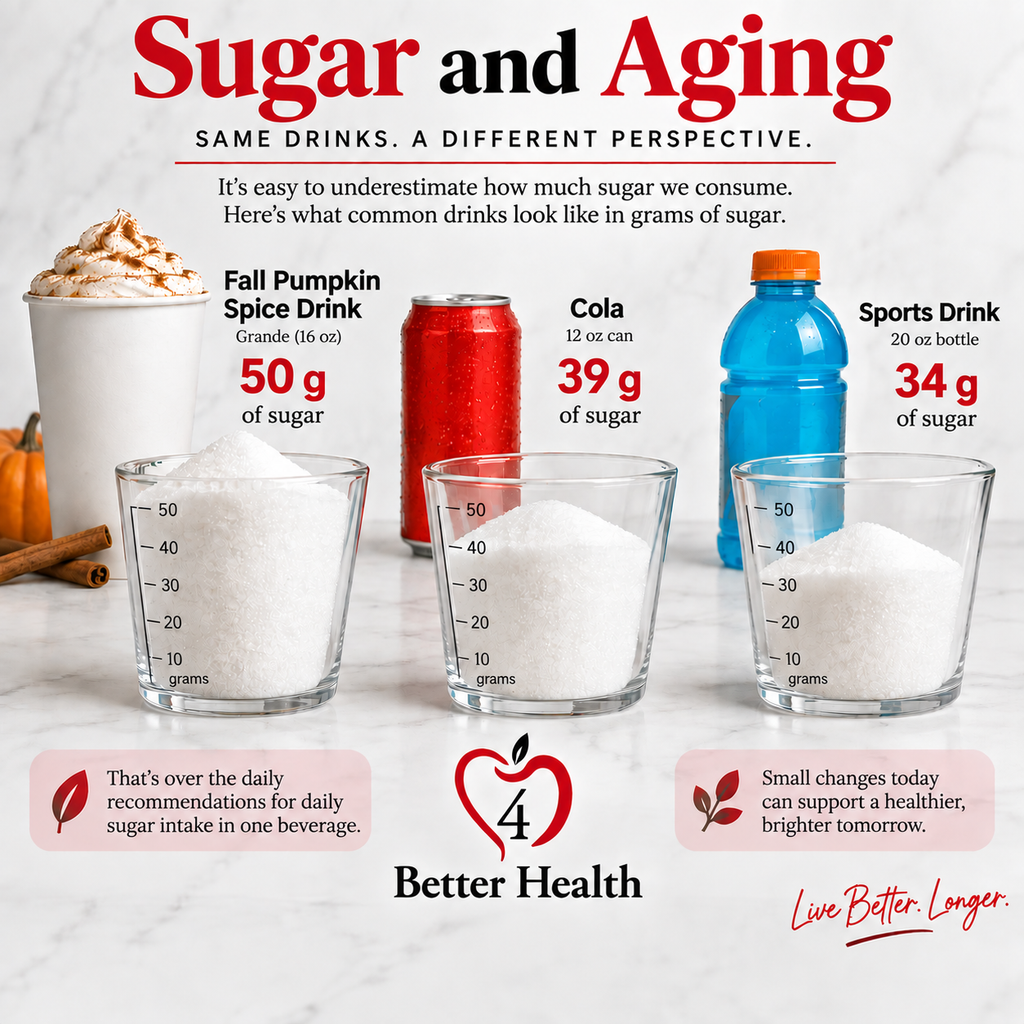
The American Heart Association recommends limiting added sugar to no more than 25 grams per day for women and 36 grams per day for men. In our practice, we simplify that message: we encourage our patients to aim for less than 25 grams of added sugar per day.
Most people recognize that cookies, candy and soda contain sugar. While you may never eat a candy bar, you may still be consuming a considerable amount of added sugar. A big surprise is how much sugar can accumulate from foods and drinks that don’t necessarily feel like dessert.
Consider your fall coffee order. The YUMMY “Pumpkin Spiced Latte” coffee drink can easily deliver an enormous amount of sugar before you’ve eaten breakfast. Depending on the drink, size, milk, syrups and toppings, these drinks contain 50-85g of sugar each. That means one sweetened coffee can potentially 3 times an entire day’s recommended added sugar before you’ve eaten breakfast.
And coffee isn’t the only place sugar hides. Look closely at flavored yogurt, granola, protein and energy bars, cereal, bottled smoothies, juice, sports drinks, kombucha, coffee creamers, oat milk, salad dressing, barbecue sauce, ketchup, pasta sauce, breads, muffins, flavored oatmeal and packaged “healthy” snacks.
“Natural Sugars are better”
This is a common misconception when it comes to replacing white table sugar with honey, maple syrup, agave or coconut sugar. While this may sound healthier because these sweeteners are marketed as more “natural.” They are still very high glycemic (i.e.: not at all metabolic freebies).
Honey and maple syrup may contain small amounts of minerals or other compounds, but they still provide significant amounts of simple sugars and still contribute to your overall sugar exposure. In fact, the World Health Organization includes honey and syrups in its definition of free sugars.
Fruit is different. A blueberry contains sugar, but it also comes packaged in a whole-food matrix with fiber, water, micronutrients and plant compounds. Digestion and absorption are different than drinking a sweetened beverage or eating concentrated added sugar.
But how we consume fruit matters. Juicing removes much of the fiber and makes it easy to consume the sugar from several pieces of fruit very quickly, which can produce a much faster glucose rise than eating the whole fruit. Dried fruit is also highly concentrated. Once the water is removed; a small portion can contain the carbohydrate and sugar from several servings of whole fruit and can be surprisingly easy to overeat. Both fruit juice and dried fruit can therefore create a much higher glycemic load than we might expect from something labeled simply as “fruit.”
We need to consider the food, the form it comes in, the amount, what we eat with it and our individual glucose response. This is why simply asking, “Does this food contain sugar?” isn’t empowering you to have the control you’re looking for when making healthier metabolic and aging choices.
The “Sugar-Free” Health Trap
Sugar Free. Zero Sugar. Keto. Low Carb labels don’t automatically make them healthy. Some of these foods contain non-nutritive sweeteners or sugar alcohols. These products can certainly reduce actual sugar and carbohydrate exposure, and some non-sugar sweeteners have little immediate effect on glucose. But replacing large amounts of sugar with an unlimited amount of intensely sweet, processed food can actually shift taste buds (making us crave sweeter foods) and our microbiome (gut bacteria which helps our immune system, neurotransmitter production and overall metabolism)
The World Health Organization recommends against relying on non-sugar sweeteners as a long-term strategy for weight control or reducing chronic disease risk.
What Does Sugar Have to Do With Aging?
Quite a bit. It can influence the biological environment in which we age. *This section may be too much science for some. We get that. And we want you to understand it and be empowered as to all the whats, whys and hows.
One way is by glycation (excuse the science words here) When sugars react with proteins, fats and other molecules in the body, they can eventually form compounds called advanced glycation end products, or AGEs. AGE accumulation has been associated with oxidative stress, inflammation, tissue stiffness and age-related chronic disease. Collagen is particularly vulnerable to glycation, but the effects extend well beyond your skin, joints, hair and nails.
Blood vessels, nerves, kidneys, the cardiovascular system, skeletal muscle and the brain can all be affected by the metabolic environment created by chronically elevated glucose and impaired insulin sensitivity.
Your Muscles Are One of Your Best Glucose-Management Tools
This is one of the most overlooked pieces of the healthy-aging and prevention for disease “secrets”. Skeletal muscle is a major site of glucose disposal. After you eat carbohydrate and glucose enters your bloodstream, insulin helps move that glucose into cells. Your muscles represent a tremendous reservoir capable of taking up and storing glucose.
The more metabolically healthy and active that muscle tissue is, the better equipped the body generally is to handle glucose. This becomes increasingly important with age. Adults tend to lose muscle mass and function unless they deliberately work to maintain it. At the same time, insulin sensitivity often reduces
Less metabolically active muscle → poorer glucose disposal → greater insulin demand → greater likelihood of insulin resistance.
This is one reason we talk so much about strength training, adequate protein, daily movement and preserving muscle as people enter their 40s, 50s, 60s and beyond. Muscle is a metabolic organ and the ONLY one we can control. Easy and fast addition to start to focus on this would be to add movement after eating. Even taking a walk after a meal gives your muscles an immediate reason to use circulating glucose.
The Spike, Crash, Craving Cycle
Have you ever eaten a high-carbohydrate breakfast and felt hungry again two hours later? Or had a sweet coffee and pastry in the morning followed by fatigue, brain fog or cravings before lunch? This may be because of high glucose spikes and drops.
High-sugar/high-glycemic meal → glucose rises quickly → insulin rises → glucose falls → hunger, fatigue or cravings → another quick source of carbohydrate → repeat.
And without a continuous glucose monitor (CGM), we don’t know this is happening but may look like this: 2 PM exhaustion. Brain fog. Irritability. Difficulty concentrating. Constant snacking. Sugar cravings. Feeling “hangry.” Needing caffeine to get through the afternoon. While glucose is supposed to rise after eating, we want to prevent this glucose up/down pattern and know what the patterns are.
How high does it go? How long does it stay elevated? How quickly does it return toward baseline? Does the meal produce a large spike followed by a significant drop? Does that pattern happen occasionally, or repeatedly throughout the day? Sometimes what feels like an energy problem is actually a metabolic pattern.
What Can a Continuous Glucose Monitor (CGM) Teach You?
One of the most interesting tools we use for metabolic education is a CGM. A CGM allows you to see glucose patterns throughout the day rather than having a fasting glucose or A1c done once or twice a year (which is retroactive and not in real time). A CGM system designed for people who want to understand how their blood sugar is rising and dropping all day, every day in real time. How does food, sleep, exercise and stress effect their blood sugar in real time. No prescription required.
For example, you can see what happens after:
Ceral, bagel, muffin or oatmeal versus eggs.
A protein smoothie versus whole fruit.
Sushi versus grilled fish and vegetables.
Your favorite restaurant meal.
A glass of wine, beer or cocktail
Dessert after dinner – dinner with no walk or a 1-2mile walk after eating.
Poor sleep.
Stress.
A strength workout.
And this is where things become very individualized. The food that creates a significant glucose rise for one person may produce a very different response in someone else. You can also experiment. What happens when you eat protein and vegetables before the starch? What happens when you reduce the portion? What happens when you add fiber? What happens when you walk for 10–20 minutes after eating? What happens after a poor night’s sleep?
A CGM isn’t a diagnosis, and every glucose rise doesn’t need to be “flattened.” CGMs measure glucose in interstitial fluid rather than directly in blood, so readings can also differ somewhat from a fingerstick. The value of the CGM is in identifying patterns and learning what improves them.
Your Brain Cares About Insulin Too
The relationship between glucose metabolism and brain aging has become an important area of research. People with diabetes have higher rates of cognitive impairment and dementia than people with normal glucose tolerance. Diabetes can also damage the blood vessels supplying the brain increasing stroke risk, and impaired insulin signaling within the brain is being investigated as one contributor to Alzheimer’s disease. Researchers have found is that insulin signaling, glucose metabolism and brain energy metabolism appear to be involved in cognitive health, and insulin resistance and diabetes are associated with increased risk of cognitive impairment.
Your metabolic health and your brain health are connected. Protecting insulin sensitivity in midlife may be one of several modifiable factors worth addressing when we’re thinking about long-term brain health.
What About Heart Disease?
The metabolic story doesn’t stop at diabetes or dementia. Higher-glycemic dietary patterns have been associated with increased cardiovascular risk. In a large international prospective study, diets with a higher glycemic index were associated with greater risk of cardiovascular events and death.
Prediabetes and insulin resistance aren’t conditions we should ignore simply because someone hasn’t developed diabetes yet.
They are signs that metabolism is changing. And that gives us an opportunity to intervene. You can have “Normal” glucose and still be developing insulin resistance This is why we don’t look at glucose in isolation. Your body may compensate for years by producing more insulin to keep fasting glucose within the normal laboratory range. Eventually that compensation may become less effective. Waiting until glucose finally crosses the threshold into diabetes misses years when metabolic changes may already be developing.
That’s why a more comprehensive metabolic assessment can include markers such as: Fasting glucose + fasting insulin + hemoglobin A1c + C-peptide + triglycerides + HDL + Inbody composition scan, interpreted alongside nutrition, activity, muscle mass, sleep, family history and other risk factors.
Start With Paying Attention:
Healthy aging doesn’t require never eating birthday cake, skipping dessert on vacation or saying no to every pumpkin spice latte. There will always be holidays, vacations, birthdays, weddings, dinners out and celebrations, and food is part of enjoying life. The problem is that our “special occasions” often happen much more frequently than we realize.
Friday night dinner becomes Saturday brunch. Then there’s the football game, the birthday at work, the coffee on the way to an appointment, the takeout on a busy night and the dessert because it’s been a long week. None of those choices individually defines your health. But collectively, they can add up. And the more frequently we eat highly sweetened foods, the more we may reinforce the desire for them. What feels like an occasional treat can quietly become part of our everyday routine.
Start with paying attention. For the next few days, become a sugar detective. Read all nutrition labels and pay attention to both the grams of added sugar and the serving size. A product containing 8 grams of added sugar per serving looks very different if you routinely eat two or three servings.
Don’t have a label? Look it up. Before ordering your favorite coffee, smoothie, refresher or other takeout beverage, Google its nutrition information. You may be surprised by how much sugar is hiding in a drink that doesn’t taste like dessert. Then try tracking your added sugar for just a few days. You don’t necessarily need to count it every day for the rest of your life. Consider doing a three- to five-day “sugar audit” periodically (maybe once a month) to see where you actually land. Even more powerful if it’s combined with the CGM to see in real time what’s happening with different foods, drinks, exercise, stress and sleep.